268. Caught in the Middle: Leading When You Disagree
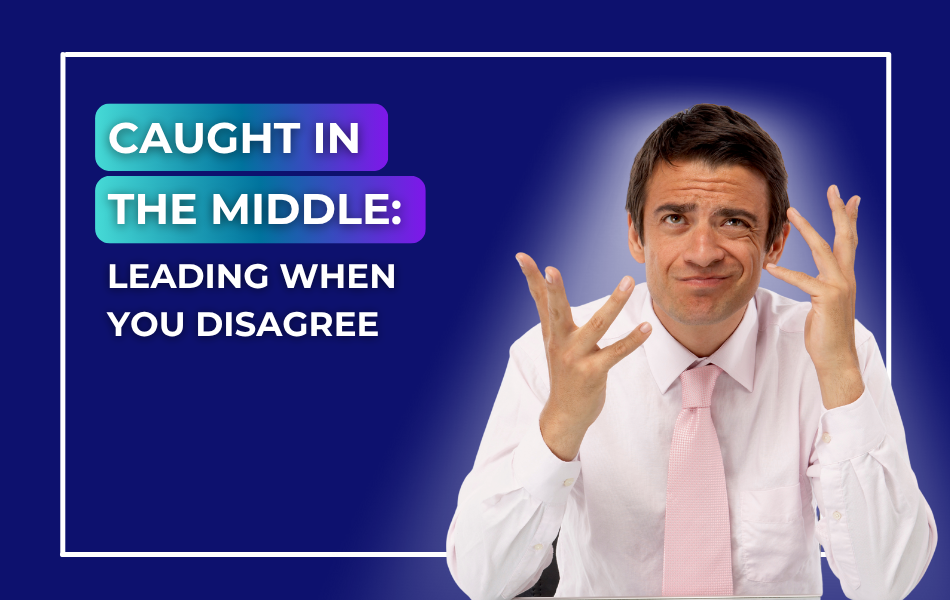
Caught in the Middle: Leading When You Disagree
About this Episode
Ep. 268 – Ever been told to roll out a new initiative or share a message that felt… off?
Not illegal. Not dramatic. Just something that didn’t sit right with you. Like telling your team “everything’s fine” when you know layoffs are coming. Or backing a tool you’re not confident in. Or pushing out a company message that feels disconnected from your own values.
If that’s ever been you – or might be one day – this episode’s for you.
Ramona shares what happens when your role as a manager puts you in the middle of decisions that don’t feel great. She names the tension a lot of us feel but don’t always talk about, and walks through a simple way to think through what to do next – without losing yourself in the process.
What we’ll talk about:
- The kinds of value clashes that come up more than we admit
- What not to do when things feel off
- A clear way to figure out how to respond – and where to draw the line
You don’t have to choose between doing your job and staying true to yourself. But you do need a way to think it through.
Listen now on our Spotify, Apple Podcasts, or YouTube
Listen on



share this story
Episode 268 Transcript:
[00:00:00] This episode is about what to do when the company line doesn’t sit right.
Here are the two questions. This podcast answers. One, how do you successfully transition into your first official leadership role? And two, how do you keep climbing that leadership ladder and continuously get promoted,
although the competition and the expectations get bigger. This show with The Manager Track podcast will provide the answers. I’m your host, Ramona Shaw.
I’m on a mission to create workplaces where work is seen as a source of contribution, connection and personal fulfillment. And this transition starts with developing a new generation of leaders who know how to lead. So everyone wins and gross. In the show, you’ll learn how to think, communicate and act as a confident and competent leader.
You know, you can be.
Welcome to The Manager Track podcast. Today I wanna give you a brief, but hopefully thought provoking and insightful and helpful episode. This is going to be focused around what to do when your values clash with [00:01:00] what’s being asked of you, or when you trying to lead with integrity, but you’re feeling totally conflicted. So think back of an example where you might have been asked to, let’s say, roll out a new initiative or support a decision or deliver a message that just didn’t sit right with you. It wasn’t illegal, it wasn’t outrageous, but you knew it was off.
You probably felt a bit of a knot in your stomach and maybe you could name it and it was very clear what it is. Maybe you couldn’t name it, you just felt like, I’m not doing what I’m supposed to be doing. It could be that you’re being told to assure your team that everything will be fine when you know that layoffs are coming or you’re being asked to roll out an AI tool and to tell people that everything is gonna be fine and their jobs are secure when you know that is not true either.
The AI tool’s not ready. It’s not [00:02:00] secure enough or, you know, this tool will be piloted and then once this is successful, your team or certain people on your team will be eliminated, or maybe you’re being asked to post a company message on social media about a social issue, let’s say, that doesn’t either align with how you actually think or feel, or you realize it’s sort of proforma. It’s a bit of a PR stunt. It’s not actually what the company lives by and stands for. It’s more so a checkbox because the company feels like they need to post button. So if you’ve been there big or small, you are not alone.
This is fairly common and happens more often than we like it to see. And the reason why this is tricky for managers particularly is because you are living in the, middle space and you’re expected to execute those top down decisions while also protecting your team and staying true to your [00:03:00] personal and professional ethics in order to build trust, right, and to be a manager that your team wants to work with or for that they trust and they have a relationship, and if you are compromising that, you realize you’re gonna lose.
Their buy-in, their alignment, and then how are you supposed to execute those top-down decisions? It is really that sandwich and a difficult line to walk. So today we’re gonna talk about what happens when those two things collide. When you feel you have to compromise one or the other, or you’re compromising yourself.
Or specific, more specifically when the organization’s expectations conflict with your sense of what’s right and what you think you need to do and we’re gonna talk about how to navigate some of those most common scenarios managers are facing right now.
It could be from AI adoption. You don’t believe in politically charged messaging you’re uncomfortable with to being told to put [00:04:00] the business first at the cost of client care or team morale. Now again, I wanna emphasize this isn’t about dramatic whistle blowing moments.
It’s about those quiet here or there, type of erosions of integrity that happen when we don’t have the tools and the language to navigate the gray areas.
So let’s get into it, and I wanna briefly talk about why it is more common than we might like to admit. The assumption that once a decision is made at the top, managers will carry it out without internal conflict because it’s top down and there is an authority or a hierarchy present in an organization that ultimately they’re asking you to just get on board and to represent leadership, but the reality is that’s not how we humans work, right? We know that from our own experience, but also we see this in research [00:05:00] that talks about the biggest drivers of what we call quiet quitting.
That isn’t laziness or entitlement. It’s disengagement from compromised values or at times lack of recognition. When people feel they’re being asked to act against their core beliefs on a regular basis. They check out, we check out. We don’t wanna be part of this, and this is human.
This is how we are wired. It’s not dramatic. It’s usually not a big clash and a big conflict. We are realizing through these subtle discrepancies , I don’t stand by what I’m asked to do. I, there is an an issue with my integrity here. And so we quietly start to disengage.
And what’s also interesting is that often when we observe this in organizations, it’s not obvious moments. It’s not the big scandals or the [00:06:00] things that even hit the news. It’s not
again, the whistle blowing moments because they’re pretty clear cut what we are talking about. Are those slow burners, the gradual compromises that accumulate over time? The decisions that aren’t wrong exactly, but don’t feel right, aren’t aligned with your values or your integrity.
And so you feel this tension because you’re translating organizational decisions. Into the direct human impact, right? It’s one thing to decide on a company level, level, looking at spreadsheets that we need to lay off people or we need to cut that back on benefits, or we need to get everyone back into the office five days a week.
But now you are the one who’s gonna have to tell, let’s say, a single parent that within the next two weeks that will be in, have to be back in the office, which means for them, potentially
they have to set up a [00:07:00] whole other sort of support system because then could no longer operate or work from home, which is likely closer to the kids’ schools, easier for drop offs or pick offs and so forth. So you as a manager, you directly see how these high level policies affect people and affect the people that you are supposed to protect and care for and advocate on behalf of.
It’s basically when something sounds good in the boardroom, but then creates chaos on the ground, and we see this. All the time, right? You’ve probably been there at least once in either end of this, maybe as an employee or as a leader, or both.
So the question is, what will you do in those moments and to talk about that, I’m gonna share four specific scenarios that are showing up constantly in management circles. And what I encourage you to do is to see which one of those sound familiar. The [00:08:00] first one is the AI adoption without readiness or ethics.
So maybe you walk into a leadership meeting and you hear, Hey, we’re launching this AI tool next month. Make sure your team is on board, but you have a million questions, real questions and concern. You’re worried about maybe chop displacement for some of your people. You’ve read about the biases in AI systems.
You’re not convinced your team understands what they’re signing up for and what they’re feeding into potentially a learning model. You are also not clear about the safeguards for your company. And so the conflict here is progress, and trying to be adaptable versus responsible implementation.
Now, your organization wants to stay competitive, move fast, embrace innovation, but. You, and again, in this middle layer, you are thinking about the human costs and the long-term risks. For most people, it’s not that they’re anti-technology, it’s really about being responsible with the implementation and not [00:09:00] trying to rush things that then have to be back paddled and undone.
We’ve seen this with companies such as Klarna, who let go of hundreds of customer support employees, because they were replaced with AI only then to find out that that’s actually not working and they had to rehire people back. But that was a real impact on people’s lives. And if you have personal relationship with them and you’re the one who has to execute it,
that can be really difficult. So trying to explain all that to a group of people. Talking about market advantages and staying ahead of the curve can be tough when you internally are kind of resisting it. The second one are those layoffs of restructurings without transparency. Maybe you’ve heard this one. Hey, we need you to assure the team. Everything’s fine, even if you know change is coming. It’s important that we’re staying calm until the announcement is being made and that everything runs as smoothly as possible. Well, okay, now you’re caught [00:10:00] between sort of the loyalty to leadership and honesty with your team.
And your team relies on you to be honest with them, to give them a heads up when this is coming. So your boss wants stability and productivity maintained, wants to avoid drama and chaos, but you also realize that your team deserves transparency and the chance to actually prepare for what’s ahead. That’s what you would want from your manager.
And so at some point you might start to feel complicit in a deception, but you’re also trapped by organizational expectations and maybe even NDAs.
So this conflict is about short-term stability versus long-term trust. And we know once trust is broken, it’s really hard to rebuild it. So that’s the second one. The third one is around those cultural war and political signaling.
Maybe you’ve been asked. Those are things such as being asked to post a pride month message when your personal beliefs don’t align or [00:11:00] told to keep your political views neutral, even when you know policies directly affect your team member safety or rights, or when you’re asked to remove DEI commentary or initiatives when you’re such a strong believer.
Or vice versa, right? And if you are actually as the manager itself directly impacted by those things, it can get even more complex. And how do you follow through on what the company is talking about and what they’re asking of you, versus also still staying true to your own identity.
It kind of gets personal in those moments. The conflict here is between company branding and lived values that you connect to or said differently between professional expectations and personal integrity.
Now the last one that I wanna talk about here as a common scenario is this client first versus business. First question. This is fairly classic. It starts with saying, [00:12:00] do whatever it takes to keep the client happy. Even if it burns out your team, well, hold on. You’re being asked to prioritize short-term revenue over long-term sustainability to treat your people as resources to be optimized rather than humans to be supported.
So now we do everything to make the client happy, but we’re totally burning out our team. It could be asking the team to work on a weekends for a demanding client, maybe saying yes to scope creep that you know is unrealistic to manage, or it’s cutting quality corners to hit a budget.
The conflict in essence, is between immediate results and sustainability or between the quarters revenue numbers, and your team’s satisfaction and retention.
This could also show up in other ways where actually the client is being compromised. The business says, Hey, present this to the client. And you know, [00:13:00] that’s not the best product for the client, not the best solution, but the company has a, an agenda. The company wants to push a specific product line and they’re saying this is what matters.
And maybe even. Your compensation is directly connected or correlated to that incentive to sell a specific product line versus for you to look at the client and decide based on their scenario, which product would fit the best. So now we are sensing this tension between business objectives versus actual client focus.
So these are common scenarios. And if you’re listening to this and you’re thinking, okay, I’ve dealt with at least one of them then, you know, that is part of management. My hypothesis here would be that 80% of you at least, would raise your hand and saying, I’ve been there typically within the first couple of years in a management role.
That is common. It’s not that you’re doing anything wrong, [00:14:00] it also doesn’t mean that you are in the wrong organization, per se, you might think, Hey, I don’t like this. I’m gonna go somewhere else. Only to then find out this kind of dilemma shows up in different, a different shape and form, but it still shows up.
You’re gonna find yourself in the sandwich again. Not to say that there are never reasons to leave an organization because of the misalignment in values, but know that no matter where you go, these kind of conflicts will bubble up. So let’s now talk about what to do and what not to do.
And I actually wanna begin with what not to do
Because I see too many managers making these mistakes and they tend to backfire. First is. To almost ghost your discomfort, to pretend that everything is fine when it’s not.
Build up a facade, put on the mask. Pretend it’s okay. Your team can feel the tension [00:15:00] even if you never speak it. They can read your body language, your energy, maybe your mood or your enthusiasm, or probably the lack thereof. So when you fake alignment, they will likely know and that breeds this trust as much as it does to directly lie to them. Second, don’t fake alignment in meetings either
i’ve watched managers nod along in leadership meetings about initiatives that they privately hate, and then they complain about those same initiatives to their teams later, and this erodes credibility in both directions. Leadership stops trusting. Your input, you are nodding because this stuff always goes back through the back channels and lands with them.
They’ll know that you actually don’t like it, so they’re gonna start to mistrust you, nodding along and your team stops trusting your words because they realize that you nodded along in a [00:16:00] leadership meeting or you didn’t bring up your biggest concerns, but then you go back, turn their back around
and you complain about the decisions that were made. This mis, this misalignment and misrepresentation on both ends will hurt you and backfire. And by the way, this idea that what you do with your team stays with your team or what you say to a peer stays with that peer. That is nice if that happens. I hardly ever see this playing out that way.
Work with the assumption. Just like we say, whenever you write something that it sucked into the internet through an email or an iMessage or whatnot.
Assume that it will be public or visible to other people, and if there’s something that you’re not willing to share. Don’t put it in an email. Right. If we work with this assumption. Similar, if you aren’t willing for your boss or leadership in general to hear [00:17:00] what you have to say to a peer. Or to, to your team, then you might better not say that.
And I actually would lean towards, get comfortable knowing that like, it’s okay for you to say, I disagree with this, or this is really difficult for me and for your managers to know that.
So rather than just nodding along and then not talk about it, I would actually say no. Stop nodding along. Like talk about the fact that you have concerns, that you have questions, that you feel misaligned. Now that doesn’t though give you sort of, a pass to then take yourself out of it and just be like, I said no to this or I don’t like it, so I’m not gonna do it.
That is not leadership. Once the decision has been made and you are being asked to execute whether you agree or not, you are gonna have to execute. I. Okay. But this idea that you can sort of disagree with stuff behind the scenes that usually lands back [00:18:00] with leadership someone or somehow this will come through.
The third one here is to not catastrophize. Not every misalignment requires quitting or an open rebellion. Sometimes discomfort is just discomfort. Sometimes the right response is to work within the system to create better outcomes, not to burn the system down. So the goal isn’t to eliminate all tension.
It is to respond to that tension and that friction thoughtfully. So what should we do instead? And what does this thoughtful response to the friction actually look like? What I would like to share with you is a framework let’s refer to it as the three lenses.
Think of it as a way to see clearly through the fog of these competing [00:19:00] priorities. Lens, one is your value check. So when you feel that knot in your stomach, the first question is. What value is being activated or violated or compromised for you? Is it morale about right or wrong?
Is it about something professional or about competence, about quality or responsibility? Is it about trust or honesty or respect? Get clear on what it is. Hey, I am feeling tension because this decision conflicts with my value of transparency, or this goes against my professional belief that we should only implement tools we fully understand.
Too many times I’ve seen this backfire, and it’s a principle I now abide by. So those are very clear statements of what’s. The issue [00:20:00] for you, they’re not emotionally driven. You don’t seem frazzled or unclear what the issue is.
You are being specific about the value. By doing so, it helps you understand whether this is a deal breaker or a speed bump, so to say. It also helps you communicate the issue. Okay, lens two. After the value check is the impact assessment. So what’s the short or the long-term impact on your team, your clients, and yourself?
So we don’t wanna be too dramatic about something that it has a minimal or short-term impact. It’s about being realistic, knowing that in an organization it’s normal to sometimes feel misaligned, like we said earlier. It’s very likely that you’ve seen all those four scenarios play out in your own experiences.
Sometimes what feels like a value violation is [00:21:00] just resistance to change, and it can be hard to admit that it’s because we don’t wanna see the change.
We’re resisting. The change is some kind of fear. And what our brain does when we fear something is it finds all the reasons why not to engage, why not to like this thing, why not to pursue it. Our brains are really smart and they’ll present these arguments in a way that they seem so true. But when we really take a step back.
It might be that we’re just resisting the change. Now, that’s just one scenarios, but we wanna assess and make sure that we are clear what is actually the issue here and what am I worried would happen. And if there is something along the lines of, Hey, I can see if I was an affected, or this was in my team, I might actually see the benefits.
But because I don’t like the change for me or my team, I’m now turning against this. Now on the other side though, [00:22:00] sometimes what feels like a small compromise could actually be a pretty big deal. So ask yourself, where’s the line
between discomfort in actual damage between personal preference and professional responsibility for you as a manager? Let’s say if you implement this AI tool without proper training, what’s the worst case scenario? If you stay silent about upcoming layoffs, how will that affect your team’s trust in you?
If you post a message that doesn’t align with your beliefs, what does that cost you internally? Only get clear on the stakes involved in this situation. Now the third and final lens after the value check and this impact assessment is the response strategy. So choosing your response intentionally is what’s key here.
And anytime we have to make a decision, we wanna think through different [00:23:00] options. So option one might be to align publicly. But dissent privately, this means you support the decision in public forums while working behind the scenes to improve it.
So you might say like, yep, you know, we’re going to roll this out. This is going to be an exciting new initiative, and we will benefit us. But behind the scenes, you’re openly, and I don’t mean in a manipulative way, you’re openly saying, Hey, this is all good. But here is the concern that I have and I wanna make sure we are tackling this before we roll it out.
So you’re trying to improve the initiative that the situation, through this open, overt dissent, you might be pushing for better training or for security measures, or for an appropriate timeline for implementation. Or when it comes to like a client business conflict, you might be implementing the client’s demands, but you’re [00:24:00] actively advocating for team boundaries or team resources
so you’re working within the system, fulfilling your expectations, but then working towards creating better outcomes for you and your team. Option two, and how you can respond is to contextualize for your team. So instead of pretending everything is simple, you might name the complexity.
You could say, Hey, here’s what’s happening and here’s why the organization made this choice, and here’s how we’re thinking about it as a team. So you are not trying to make it all seem easy and everyone’s aligned. You’re clearly calling out, here’s what the board needs, or here’s what the C-suite needs.
Here’s what was decided as a result of that, and here’s how this will impact our team. Now we understand that the company isn’t run based on our team’s best interest. The company is run by [00:25:00] the interest of the organization and its stakeholders.
And so we as a team have to figure out how do we plug into that and how do we make this work? This builds trust through your transparency, while also still supporting
organizational decisions and trying to translate to your team why someone in the C-suite or a department head or the board has made set decision where they might be coming from and trying to create a bit more of a mutual understanding, even when we are on, when we’re disagreeing. Now the third option is to raise your concerns upstream.
So framing your concerns, not as resistance, but as thought partnership. Hey, I’m excited about this initiative and I wanna make sure we’re setting it up for success. Here are some potential challenges that I’m seeing and here’s how I think we should solve them. This [00:26:00] positions you as a strategic partner or even advisor in terms of strategic execution, not as a roadblock or someone who is refusing or resisting change.
Now there’s a fourth option, and that would be to draw a boundary when needed. So, sometimes some things just cross the ethical line. When it does, you need to be really clear about what you can and cannot do.
Hey, I am not comfortable posting that message, but I’m happy to help craft something that feels more authentic to our culture. The key is knowing where your team lies before you reach them. So that clear boundary and communicating in a way of what you can do and what you cannot do,
can be effective in that you are protecting yourself and or your team, but you’re also still demonstrating this collaborative approach. Now, here’s what I hope you’ll remember from all of this, [00:27:00] is you don’t have to choose between being a good employee or a good manager and being a good person.
The best managers find ways to honor both the organizational needs. And their personal values, and this isn’t easy. It’s a tight rope to walk, but it is possible, and I hope that these four options that we just talked about give you some ideas on how you can effectively engage in such situations depending on what the scenario is and how you want to respond.
All the while you are supporting your organizational needs and you’re staying true to yourself and advocating on behalf of your team, maintaining the trust that you built with them.
Now, before we wrap up, I wanna leave you with some questions to think about either on your own or maybe even with your team.
First, where have you recently felt an even subtle misalignment between what you were asked to do and what felt right to you? [00:28:00] Don’t touch it, just notice it.
Second, what values were intention in that moment? Honesty, loyalty, innovation versus cautiousness or responsibility, the individual needs versus sort of the collective business. Good. What was it? And then the third one is, what’s one conversation you’ve been avoiding that might restore clarity or integrity to the situation?
Maybe it is with your boss about the concerns that you have. Maybe it is with your team about challenges you’re facing. Maybe it is with yourself about what you actually believe and what’s actually making this difficult for you. The goal here isn’t to eliminate all tension. It is to engage with tension in a conscious way, rather than letting it eat away at you by either staying silent or airing out frustrations and then presenting sort of two different sides of you.
In conclusion, [00:29:00] leadership isn’t about never having doubts. It’s about holding clarity, discomfort, and responsibility all at once. The managers. Are that are most respected aren’t the ones who never face ethical friction or this tension between values, these value clashes, but they’re the ones who can navigate them with intention.
Those who find ways to stay true to their own values. While also serving the organization, their teams we’re able to work through it to execute, but voice the dissent to work on solutions, to set boundaries when needed. Now. With that, I’m gonna wrap up this episode. I hope you found this helpful. And if you do know someone who is in that situation right now, where they’re feeling conflicted, please share this episode along as it hopefully will help them think through this and also feel a bit of validation that this is a normal part of being in that sandwich [00:30:00] as a manager.
And hopefully we’ll also give them some ideas on how to move forward and if this is something that seems to repeat itself in your particular role or in your organization, executive coaching can be a great tool to help you navigate
such dynamics and friction to ensure that you are not burning bridges, not stalling your career while also still staying true to yourself. One of the issues of this that is not addressed is, you know, team loses trust.
Leadership loses trust that then leads to that stalling of a career or even burning bridges. The second thing is the emotional load that it takes the emotional energy to go through all this, and that can lead to burnout or disengagement. And we would wanna avoid all of these things.
And if you find yourself in a situation, you. Think is tricky to navigate and you’re looking for help. Check out the show notes with a link to schedule a strategy call to look at how executive coaching can help you work through such a situation. Thanks again for tuning in. I [00:31:00] wish you a wonderful week.
We’ll be back next week with another episode of the Manager Track podcast. Bye for now.
If you enjoy this episode, then check out two other awesome resources to help you become a leader. People love to work with. This includes a free master class on how to successfully lead as a new manager. Check it out at archova.org/masterclass.
The second resource is my best-selling book, the confident and competent new manager, how to quickly rise to success in your first leadership role. Check it out at archova.org/books or head on over to Amazon and grab your copy there.
You can find all those links in the show notes.
REFLECTION & DISCUSSION QUESTIONS
- When was the last time something at work felt misaligned, even a little?
- What part of you felt pulled by your sense of honesty, fairness, or responsibility?
- Is there a conversation you’ve been avoiding that might help clear the air?
RESOURCES MENTIONED
- Grab the free New Manager Toolkit mentioned in the episode: archova.org/freetoolkits
- Executive Presence Intensive: archova.org/executive-presence-program
- Learn how to turn your 1-on-1 meetings from time wasters, awkward moments, status updates, or non-existent into your most important and valuable meeting with your directs all week. Learn more: https://archova.org/1on1-course
- Schedule a Leadership Strategy Call with Ramona HERE.
- Grab your copy of Ramona’s best-selling book ‘The Confident & Competent New Manager: How to Rapidly Rise to Success in Your First Leadership Role’: amzn.to/3TuOdcP
OTHER EPISODES YOU MIGHT LIKE
- Episode 264 – Build a Team Culture You’re Proud Of — Even When the Company’s Isn’t
- Episode 129 – Creating a Feedback Culture – With Harrison Kim
WHAT’S NEXT?
Learn more about our leadership development programs, coaching, and workshops at archova.org.
Grab your copy of Ramona’s best-selling book ‘The Confident & Competent New Manager: How to Rapidly Rise to Success in Your First Leadership Role’: amzn.to/3TuOdcP
Want to better understand your leadership style and patterns? Take our free quiz to discover your Manager Archetype and learn how to play to your strengths and uncover your blind spots: archova.org/quiz
Are you in your first manager role and don’t want to mess it up? Watch our FREE Masterclass and discover the 4 shifts to become a leader people love to work for: archova.org/masterclass
Don’t forget to invest time each week to increase your self-awareness, celebrate your wins, and learn from your mistakes. Your career grows only to the extent that you grow. Grab your Career Journal with leadership exercises and weekly reflections here: ramonashaw.com/shop
Love the podcast and haven’t left a review yet? All you have to do is go to ramonashaw.com/itunes and to our Spotify Page, and give your honest review. Thanks for your support of this show!
If this episode inspired you in some way, take a screenshot of you listening on your device and post it to your Instagram Stories, and tag me @ramona.shaw.leadership or DM me on LinkedIn at linkedin.com/in/ramona-shaw
* Disclaimer: Shownotes may contain affiliate links. That means that I am awarded a small commission for purchases made through them, at no added cost to you.