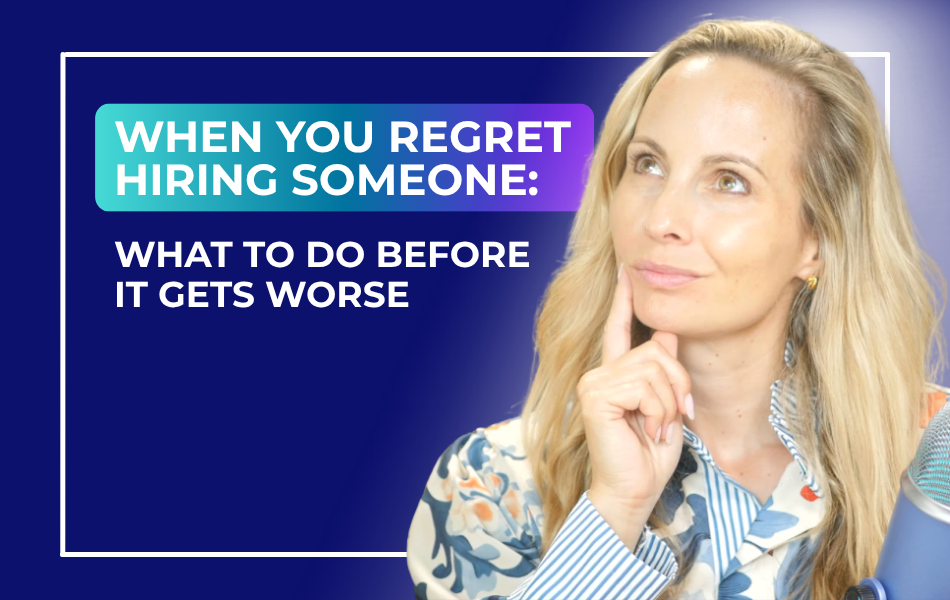
When You Regret Hiring Someone: What to Do Before It Gets Worse (Ep.308)
Do you know that moment when you realize that a new hire is not working out? Maybe it is a performance observation you made yourself over the past few weeks, or maybe someone pulls you aside (a senior leader, a peer) and shares their impression.
Either way, a thought crosses your mind: Darn, maybe I should not have hired them.
What happens next is where things go sideways. Most managers either go quiet such as privately deciding something is off but not saying anything while slowly pulling back their coaching, their attention, their investment.
Or they move too fast, making a call before they have enough information to make it well.
Both of those responses erode your leadership credibility.
‘Maybe I should not have hired them’ is not a conclusion. It is a signal and this episode is about what to do with it.
In Episode 308 of The Manager Track, we cover:
- The 4 Diagnostic Questions: the framework to run before doing anything
- The 3 Categories: how to distinguish a skill gap (coachable), a behavioral pattern (addressable with specificity), and a role-strength misalignment (the most underdiagnosed category)
- The 2 Key Conversations: what those are, including how to open each and what to listen for
Whether you are three weeks in and already second-guessing a new hire, navigating feedback from above, or simply trying to get better at turning difficult situations into clearer decisions, this episode gives you a repeatable process to use every time.
Listen now on Spotify, Apple Podcasts, and YouTube.
— RESOURCES MENTIONED IN THIS EPISODE —
- Leadership Accelerator: Archova’s 12-week manager readiness program for new and early-stage leaders: archova.org/leadership-accelerator
— LINKS —
- Schedule a Leadership Strategy Call with Ramona https://calendly.com/ramonashaw/leadership-strategy-session
- Grab the free New Manager Toolkit mentioned in the episode: archova.org/freetoolkits
- Learn how to turn your 1-on-1 meetings from time wasters, awkward moments, status updates, or non-existent into your most important and valuable meeting with your directs all week. Learn more at: http://archova.org/1on1-course
- Grab your copy of Ramona’s best-selling book ‘The Confident & Competent New Manager: How to Rapidly Rise to Success in Your First Leadership Role’: amzn.to/3TuOdcP
OTHER EPISODES YOU MIGHT LIKE
- Episode 292 — Performance vs. Potential: A Better Approach to Assessing Your People
- Episode 301 — Why Good Managers Still Lose Great People
— WHAT’S NEXT? —
Learn more about our leadership development programs, coaching and workshops at archova.org.
Grab your copy of Ramona’s best-selling book ‘The Confident & Competent New Manager: How to Rapidly Rise to Success in Your First Leadership Role’: amzn.to/3TuOdcP
Want to better understand your leadership style and patterns? Take our free quiz to discover your Manager Archetype and learn how to play to your strengths and uncover your blind spots: archova.org/quiz
Are you in your first manager role and don’t want to mess it up? Watch our FREE Masterclass and discover the 4 shifts to become a leader people love to work for: archova.org/masterclass
Love the podcast and haven’t left a review yet? All you have to do is go to ramonashaw.com/itunes and to our Spotify Page, and give your honest review. Thanks for your support of this show!
If this episode inspired you in some way, take a screenshot of you listening on your device and post it to your Instagram Stories, and tag me @ramona.shaw.leadership or DM me on LinkedIn at linkedin.com/in/ramona-shaw
This is about what to do when doubt sets in about a new hire.
Let’s say you got a new hire, someone that you and your team desperately needed. Now a few weeks, maybe a couple months in, you start to have the thought, oh man, I should not have hired them. And in those moments, that thought might land like a conclusion, almost like a verdict on their future trajectory with the organization. Now, most managers treated that way, which is exactly what actually makes the problem worse.
In this video or in this episode, we’re gonna talk about how to think about this moment. This thought, seeing it as a signal to give you indication of what you need to do in the next 30 to 60 days.
Because that will determine whether this becomes a bad hire story or a turnaround story, and whether or not you are strengthening your leadership perception in the organization or you are eroding it.
My name is Ramona Shaw and I’m the host of the Manager Track podcast.
There is something else worth naming here because it comes up more then we all might wanna admit, sometimes the doubt does not start with you. It could be that a senior leader mentions that your new hire, made a poor impression in a meeting, or someone pulls you aside and says, Hey, just so you know, and then shares some kind of information about that new hire and their interaction with them.
And suddenly you are not just dealing with a performance question of something you’ve observed, but you’re now. Also managing optics. And it probably feels like you’re managing how other people perceive you. Your ability to lead that person who make good hires and to build a strong and high performing team.
And with that, you start to feel implicated so that employee’s mistake, if you wanna call it that with this other person, the senior leader or this coworker now may start to feel like it is your own mistake and something that you need to own. And the instinct, especially when you’re early on in a leadership role and you might not feel so secure or so sure about.
How to make good hires, how to evaluate someone who’s new on the job, uh, within the first three months. And then even how to manage performance when things aren’t all rosy and amazing, early on. And then it can easily become about you protecting yourself by siding with the senior leader. And you might feel inclined to quietly distance yourself from your hire, maybe not physically or obviously, but emotionally or mentally before you’ve actually done your own proper assessment.
And on the Manager Track podcast, I wanna call out the things that are often hidden or invisible, to understand the human behavior and the psychology
of people of humans, including anyone in a leadership role. And so what happens when you have a new hire on the team and you generally think they’re doing pretty good, and then you get that feedback from another person. That is a moment where things can go south and actually can make it harder for you to build trust and respect as a leader if you’re not paying attention to what’s actually going on.
And developing that kind of awareness of, wait. What am I going to do with this signal and how is it impacting me and how I feel about this person and this feedback. Because the instinct to side with the, let’s say, senior leader or the coworker that gave you the feedback will cost you both in fairness to the employee and your own credibility as a manager.
’cause other people will likely notice it, especially if it becomes a pattern. By the way, quick side note, when I talk about this with my coaching clients, ever so often someone says, I can totally see it and I can even see how I was on the receiving end with a manager in a situation like this at some point in their career or where they observed someone else on the team who was new.
Being treated that way, not because of their actual performance or the direct, interactions, but because of hearsay feedback from others. hope that this episode and this video will give some clarity around what to do in those moments so that you know exactly how to read the signals that thought of. I don’t know if I should have hired them. We wanna make sure that that thought when that crosses our mind, we use that as a flag and are then able to diagnose what’s actually going on and make informed and timely decisions.
More specifically, this means three things. We need to diagnose what’s going on.
We need to have some honest conversations that might feel uncomfortable, and then we need to make a clear decision when it’s time to make one.
so going back to the thought, I shouldn’t have hired them. Sounds like one question, but really we need to break it up into three. The first question is, did I actually hire the wrong person? The second question is, did I set them up poorly? And then the third is, is there something fixable here?
And so when we collapse those into one feeling of like, oh shoot, I shouldn’t have hired them. We cannot act clearly. We’re now starting to act emotionally and many of us will either go silent. And try to sort of like play it out and think, okay, I shouldn’t have, but I can’t act so fast. I’m gonna let that play out and find for something a lot more obvious that then will help me make a decision, like, I’m gonna see this blow up or further escalate or something else that will make this decision so obvious and it’ll be easier to do without having to go through that harder process.
Of evaluating and having conversations on the other side, there’s a good amount of leaders who will move too fast and make a call before they have the information to actually make it. And then we’re removing that chance of the new employer to actually be successful, or for us as a leader, to learn through this process and this experience.
Because the silence and waiting for more to happen is the more common approach, managers will take. Let’s quickly talk about what that costs. When you privately decide someone is not working out, you might not say something, but you’re likely stopping to invest in them. You might be pulling back your feedback. Uh, you might not give them the attention that you would typically give.
You might not, uh, invest as much into coaching conversations and most employees will sense it. They may either realize like, this is something about me in this role, they just start to think that you’re not a good leader, that you don’t know how to manage well, you don’t know how to coach, you are not good with feedback.
And they’re losing trust and respect for you in the process, which we can already, you know, fast forward, we know that’s probably not gonna be good in trying to turn this situation around. As a result of you pulling back and them having some kind of interpretation of what might be going on, it’s likely that their performance gets worse, not better.
And then it confirms your doubt and their doubts as well. And now we found ourselves in this downward spiral or loop
now research on the manager attribution error here is pretty clear. New hire underperformance is co-created more often than managers recognize. It’s about the. Onboarding quality, the role, clarity, expectation, settings, all those are leading contributors. Now, that doesn’t mean that every struggling new hire is a management failure, but it does mean that you owe it to yourself and the employee to have an honest look at yourself and what you did or are doing before you attribute this issue solely or predominantly to the employee and on the senior leader scenario specifically, their reaction to one meeting is just a data point. Your two months of direct observations is also a data point or lots of data points, but those are not the same thing.
Acting as if they were and as if their observation. Would be equal to your observations is where managers make those avoidable mistakes. So again, the thoughts that you have internally, the feedback that you’re getting, uh, the observations that you have. That is data. The silence about all of this is then what leads to a leadership problem.
So before you do anything, run through four questions and these will tell you what you are actually dealing with. Question number one is, was the role actually clear? Did this person have a written role profile with specific success metrics before the end of the first 30 days. And I don’t mean a job description, I mean a clear articulation of what good looks like in their first 60, 90 days and beyond what they own, what decisions they can and should make, and how success is actually. Measured plus, it should also include what behavioral norms and standards that you’re expecting.
It should make those assumptions and often implied expectations really clear. It can be. As simple as when I email you, I do expect a response within the same day. If that is, for example, an expectations that you have that needs to be articulated, if you encounter a problem that you are able to solve, still inform me about it.
I’d rather know than not know, and you telling me that there’s a problem you’re dealing with. Doesn’t mean you’re not doing well with the job. Doesn’t mean that there’s an issue with your competence or your capabilities. It also doesn’t mean that I need to step in and help, or that you’re asking me for help, but I need that level of transparency.
Some managers don’t, some organizations don’t work that way, and most of the time when we have new hires, we don’t have the full picture of. What kind of organizational norms and behaviors they’ve been trained on or they’ve sort of adapted to over time. And then they come in and unless told otherwise, they’ll probably keep doing the same things.
So again, role clarity, clear expectations, success metrics and measurements and behavioral expectations. The assumptions that you have and you think that’s so obvious. If they’re not doing it, it might not be that obvious. Okay? Because at the end of the day, you cannot hold someone accountable to a standard that you did not clearly set.
Okay, so that was question number one. Question number two, what was the onboarding process like? I mean. Honestly not what you intended it to be, but what actually happened? Was it structured? Did someone own it or did you point them to a few people, like go reach out to them or, or that person?
Did you show them around or did you assume that they will figure it out? Did they have access to all the tools that they needed? Did they have it support? Did they meet with hr? Did you make introductions to be set up for success? Did they have a chance to bond and actually get to know their team,
not just about tasks and work, but also on a personal level so that they feel more engaged and connected. After the first 30 days, all of those things matter. Humans aren’t machines. We are not robots. We are coming into a team, into an organization, both with a focus on results and driving work, as well as that human social component that we are wired to have and,
that does. Influence how we show up. There’s some fascinating research out there on how someone who feels rejected or ignored by a group, how their ability to focus diminishes. How their ability to problem solve diminishes how their willingness to help a team member is being reduced.
It has a significant ripple effect when someone doesn’t feel included and welcomed. So if your new hire has been struggling early on to get traction. It’s worth asking how much of that is because nobody actually showed them how to get traction here, and we didn’t set up the environment for them to actually be successful.
Okay. Question three. Is this a skill issue? Is this a behavioral or an attitude issue? Or is this a issue with the fit, their strength profile not matching the role profile? So strength profile of a human role profile of what is required in this position.
Are these two maybe not matching? And this is the most important distinction and being really clear of what is the issue here is, a really important part of the process and not something we wanna skip over if it’s a skill issue, maybe they cannot do it yet. Maybe their capability is not there and, but possibly this is trainable. You need to determine whether the gap between what their current skill level, and what is expected can be closed in a reasonable.
Timeframe. Now, if you work at a startup, for example, and it’s fast paced and people need to hit the ground running, it’s likely that you don’t have three to six months to train someone up and to bridge that skill gap in a more established organization or team, you might actually get there or that might be your only option because the niche that you’re working
it’s very unique or specific, and so any new hire will have to go through a steeper learning curve. All that matters. That is the first, the skill issue. Now, the second one is sort of the behavioral, the attitude issue.
Here’s what to establish is do they know what is expected and are they actually choosing not to meet it? So this goes back to the earlier question, did we clearly communicate it? And we can clearly determine that despite them knowing they’re actually choosing not to do it. Not to meet those expectations.
Does it show up as insubordination? Are they unreliable or are these negative patterns continuously showing up even after really clear feedback? And not just feedback, by the way, would that be dumped on them, but their commitment to the change? If I say to someone, Hey, you are running 10 minutes late to most meetings, and that’s becoming an issue, we all do our best to be on time and of course every so often someone might be running late, but that should be the exception and not the norm. That is really important for us. Is this something you’re able and willing to work on so that going forward you are rearranging your schedule or your timeline so that you are joining our meeting like everyone else from the start. if they then said sorry. Totally. Yes. Uh, there’s a reason why that happened or even, uh, okay. I didn’t realize this was so important. Absolutely, I will make the changes necessary to be there in the beginning.
If they said that they made that commitment and then still don’t do it right, we get really curious of like, why is that happening? But that’s an indication that, hmm, maybe there is like a behavioral or an attitude issue going on, not just a skill issue. If they’ve never actually committed to that change, then we have to do more work first.
Now the last issue here could be that that fit issue, right? Strength, pro profile versus role profile. If they have real talent and real strength, but the role is kind of working against them. For example, I had a client once who was praised for their strategic thinking and strategic perspectives, and that was the thing that got them promoted. Then suddenly there was a reorg and people were laid off and suddenly this person was now no longer in a role where they had the capacity to do the strategic thinking. Suddenly they were all into the weeds, super execution heavy. Because they had to do, because they had to carry the actual day to day load that.
Previously, his team was handling now suddenly. He was the one who took care of it. Now, as you can probably imagine, their strength of being a strategic thinker suddenly didn’t really play into this anymore on whether they were going to be successful in that particular position or not. So those are the questions we have to ask ourselves.
Similarly, to give you another example, if someone who works best independently is suddenly placed in a highly. Visible collaborative position that may not be a good fit. Gallup has some research on strength-based performance, and they’re really direct abouts of their conclusion. People don’t fail because they lack talent. They fail because they’re deployed in the wrong conditions, which another quick side note, if you are leveling up in your career, in every new role, every new chart that you take on, you wanna make sure that you.
Increase your understanding of what types of conditions you will thrive in and in which conditions you won’t. And then you only take on roles and say yes to job offerings that match the conditions in which you thrive because. Further up that you go every failure, every , missed opportunity to sort of demonstrate your skills and your talents and accelerate is becoming more and more costly.
Okay. Side note, closed. What we’re talking about here is that third question of like, what is actually going on? And we looked at three different aspects that we have to separate in order to know how to best intervene in that situation.
Now the fourth question to ask yourself is, what is the trend line here? Is this deteriorating? Is it kind of flat or is it showing any sign of improvement? One bad month and a sustained downward spiral on not the same situation.
And do not call for the same response as one bad week or one bad meeting. So if a senior leader’s impression triggered your doubt, this is where you check your own trend data. Does what they observed align with what you observed or does their read standalone and is disconnected from what you actually seeing or blown out of proportion?
Even though we are biased and it’s kinda hard to separate, but we all know that we cannot diagnose performance with a gut feeling, right? We do have to run these questions first and become really reflective and clear on what we’re actually observing.
Now let’s take a quick pause. If this episode is landing for you and you are in a manager role, where you are navigating performance issues, accountability conversations, or are trying to build better leadership habits overall. I wanna tell you about the leadership accelerator.
This is our 12 week manager readiness program that we run specifically for new and early stage managers. People who are good at their jobs, they’re even excellent, and now they need to become good or great at leading. We go deep on exactly this kind of thing and how to diagnose what is actually happening with your team, how to have the direct conversations without them going.
Sideways and how to build accountability systems that actually hold so that you are not constantly trying to pull the strings on everyone and feel like you have to be on top of all their work. This program is cohort based, so you go through it with other managers, a small group of managers who we’re navigating very similar challenges.
The program is very deliberately designed to support your growth in terms of competence, and confidence in a range of different leadership in the most important aspect of leadership.
This program has been running and proven with high success rates for eight years now. And our participants keep coming back, raving about the program and how much it’s changed their career trajectory and their ability to lead.
So if you lead a team and want to build this capacity, competence and confidence for your team and to position yourself well for future leadership roles. Or if you are leading managers and want to provide this to the people on your team, then check out the link to the leadership accelerator in the description.
So once you have run your diagnostic, you ask yourself those four questions and gave yourself some honest answers. Going to land in one of the three categories, and each one calls for a different response Category one is the skill gap,
where the capability is just not there yet. Now, before you decide what to do, answer a few questions. One, can this gap close in a reasonable timeframe? Wait, what does measurable progress look like in 30 days? What support pairing or training would actually move the needle? If you can answer those and build a real plan around them, then this is likely coachable.
If 30 days of structured support produces no movement, you now have different information, a better signal, and that is also useful. So ask yourself these questions and then develop a plan.
Category two, be the behavioral challenges. This is the sort of insubordination, the on reliability, maybe attitude, friction
that is costing the team not a one-off bad week, but a pattern. Now, this is not automatically uncoachable, but the process is different. You have to name the specific behavior, not the general vibe, such as you seem disengaged or not A team. That is not feedback. Hey, In the last three team meetings, you interrupted two colleagues, which made them feel like you’re shutting down their ideas. This is feedback, you name it, and you set a clear expectation. Then after that, um, on what you’re expecting instead. You also give them the opportunity to respond and explain themselves whether you agree with their explanation or not.
It’s important for you to understand what was going on, what was driving the behavior, ’cause that insight will help you make a decision on how to support them and will help you make a decision down the road if this is really not a fit. if the pattern continues after you’ve had these conversations and you documented the process, then you probably have your answer.
The third category is about that role and strength profile, misalignment and in my opinion, this is the most underdiagnosed category and the one where managers carry the most responsibility. The hire might be genuinely talented.
They are just in the wrong context. The role asks for things that work against how they think, how to communicate or operate. And this is not a performance failure, it is a deployment failure. And the way that you find out is by having conversations directly. Especially the uncomfortable ones, you really wanna dig into.
How do they feel? Where do they think, what do they think their strengths are? How are they deploying their strength? You wanna share that you have concerns about the match or the fit, and you’re trying to hear their perspective on how to make that fit better. And it’s important to call out that this isn’t about their talent.
But about the match and exploring ways to improve that match, if at all possible. If he could conclude the issue is about one category, when it really isn’t, then we’re going to intervene in the wrong and inappropriate way.
So getting the diagnosis right is the first and most important thing,
As it’s probably pretty obvious by now, I am advocating for having difficult conversations, honest conversations, and the two most important conversations that managers may avoid, um, but are crucial to have, are the following.
Number one conversation. The role and strength discussion, right? So do not wait for a formal review half this early, and as I said a minute ago, really call out that you’re concerned about this match and you wanna figure out how to increase a strength in that match.
Open with, I want to have a conversations with you about how things are going. I’ll share what I’m observing and I wanna hear. Your observations. I also like to understand what’s feeling natural to you in this role and where you feel like you are grinding where it’s difficult.
Then. After that name what you are seeing specifically. Hey, I’ve noticed that the client facing part of the role, the piece that requires you to be out front and selling the idea in the room, that’s where things seem to slow down. The analytical work on the other side is really strong, but the influence side or the relationship part is where I’m seeing a gap and I wanna address this early.
What is your read on that? To call it out directly and then listen, like see whatever comes back, will tell you whether this is a skill gap, that they’re aware of and want to close. If it’s maybe a fit issue they’ve been quietly struggling with and didn’t wanna say, or something neither of you had fully named yet, and it might create a lot more clarity.
This conversation, by the way, also protects you from acting on someone else’s impression right before you’ve done your own assessment. So if a senior leader flagged something, this is where you test whether a read is consistent with maybe not yours, but the employee’s own experience, or if it was just a moment out of context.
So that’s the first conversation. The second conversation is the accountability conversation. This is for behavioral or attitude type issues, or generally just when a behavior that has been named continues in those conversations, start off saying like, Hey, I want to revisit something we’ve talked about a few weeks ago.
Then name that specific behavior you’re calling out. I said at the time, this needed to change and you agreed to that and made a commitment. But since I’ve seen the specific behavior, you know, reoccurring, so I wanna understand what’s getting in the way.
Again, you’re calling it out and then you’re being curious. You’re not telling them this needs to change. Now. What are you going to do without giving them a chance to reflect on their own? When they then reflect and try to give you an answer to that,
listen to the answer, learn from it, and then be really clear about what comes next. Here is what I need, that specific behavioral change by this date. And the reason for it is like, because you need to give some kind of why, why this behavior matters and why this is important.
Then you can say, I’ll check in with you on that later date. And if you’re not seeing consistent change by then, we’ll need to have a different conversation about whether this role is the right fit or where to go from here.
Yes. Don’t say things such as like, let’s see how it goes. I know you can do it.
It’s great. Thank you so much. You have to be really specific because otherwise you’ll find yourself kind of repeating that same conversation again, but four weeks later and early on with new hires even later on, as I’m saying this, but specifically early on. Timing matters. If someone’s not working out and you’re letting that go on for six months,
that’s not good leadership. You notice something, you see it, you name it, you address it right away, and then you gather enough information to make a decision.
So I’m gonna tie this back to the beginning. We started off with that thought, oh, I shouldn’t have hired them. When that arrives and when that crosses your mind, or if it does, that is the reset.
Right it. Catch it before you go quiet, before you pull back, or before you let someone else’s impression become your decision so that it moves you from conclusion mode to diagnostic mode. And that is leadership strength. So instead of this is what is happening to what do I actually know and how are we going to proceed,
now let’s bring something else onto the table here. The thing most managers will not say out loud is that when a hire does not work out, the failure rarely gets examined. Managers absorb the frustration a hundred percent, and uh, they then have to carry the extra load and the team is frustrated and they are working through supporting their team.
They just don’t have the time in the midst of all of that to be self-reflective and to slow down before they speed back up again. They’re in that like frustration, urgency back into action mode too soon, too fast. Many of them, not all of them, and then it’s really easy to run that same exact process over and over again without actually causing us to learn and grow through the experience Every difficult hire, regardless.
Of how it resolves is a chance to tighten your leadership competence and your leadership system. Like what did you assume in the interview that you should not have? What would you look for differently? What would you change about how you onboard the next person? Most managers never really ask. Those questions and they treat the bad hire maybe as a fluke or their problem, but not our problem and not as feedback on the process.
Or by the way, they go too much into guilt mode and take on too much, which can also hinder the actual growth and making the updates because now we start to personalize it and we are losing confidence in ourselves as the manager. Both of those options not effective. It’s really about getting clear of what happened and how are we improving our competence in our leadership system.
The managers who get consistently good at this are not better at predicting who will succeed. We all make hiring mistakes. There’s not a single manager or leader out there that I know of who’s not hired. Mismatched people like that happens all the time, but they move faster, diagnose more accurately, and come out of each difficult hire with sharper intake, sharper onboarding, and without burning britches with those employees.
’cause they know how to handle such situations with empathy, care, clarity, and kindness.
So again, the thought of I shouldn’t have hired them is not the problem. But what you do with it. Might be a problem. If this episode was useful, please share it with a manager who is navigating something similar right now or has recently done so. I’ve linked a few related episodes below as well and I hope to see you next week.
Another episode of the Manager Track podcast. Thanks so much and bye for now.