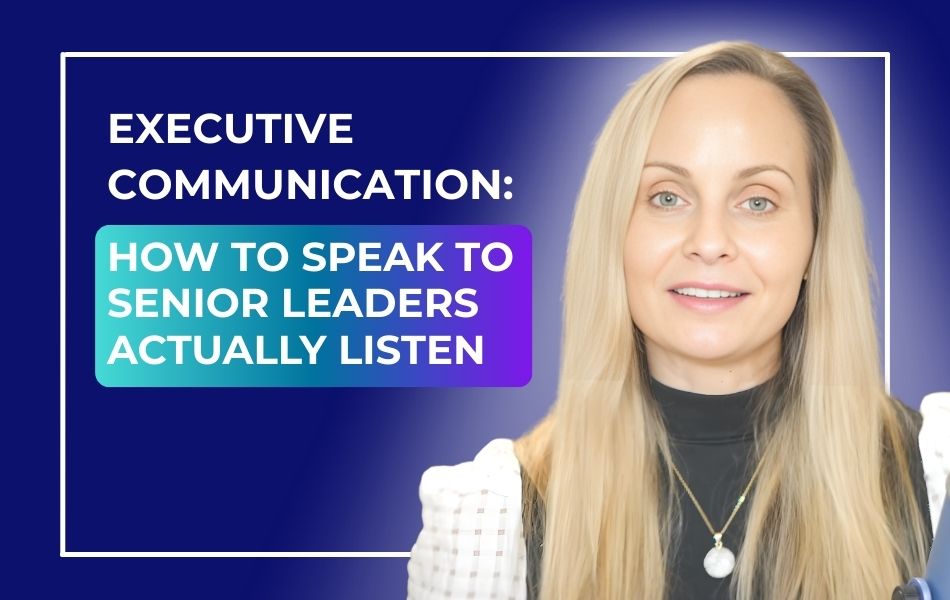
Exec Communication: How to Speak So Senior Leaders Actually Listen (Ep 303)
Ramona opens this episode with a pattern she has observed across years of coaching leaders at every level: the most technically sharp person in the room often isn’t the most influential one. She argues that communication problems are almost never vocabulary problems. They are frame problems. And she walks through a practical system for owning the architecture of any high-stakes conversation before it starts.
Ramona introduces the CLAR Clarity Signal System, a four-part mental model covering certainty in delivery, leading with impact, anchoring to specifics, and redirecting under pressure without retreating. She also addresses one of the quieter traps in difficult conversations: the need for closure and why chasing it tends to make things worse.
Key Takeaways
- Confidence in delivery signals competence more reliably than content alone. Research on manager presentations confirms this directly.
- Every conversation has an invisible architecture. Strong communicators don’t accept the frame they’re handed. They reset it early and hold it.
- Hedging phrases like “I could be totally wrong, but…” pre-discount your own point before anyone else has a chance to engage with it
- Closure is a feeling. Clarity is a decision. You don’t need the other person to agree in order to move forward.
Try this this week: Before your next meeting where you expect to be put on the defensive, prepare two ways to reset the frame.
Practice the line: “Happy to shed some light on this. Can I give you the two-sentence context that makes this a lot easier to follow?”
Listen now on our Website, Spotify, Apple Podcasts, and YouTube.
RESOURCES MENTIONED
- Schedule a Leadership Strategy Call with Ramona https://calendly.com/ramonashaw/leadership-strategy-session
- Grab the free New Manager Toolkit mentioned in the episode: archova.org/freetoolkits
- Learn how to turn your 1-on-1 meetings from time wasters, awkward moments, status updates, or non-existent into your most important and valuable meeting with your directs all week. Learn more at: http://archova.org/1on1-course
- Grab your copy of Ramona’s best-selling book ‘The Confident & Competent New Manager: How to Rapidly Rise to Success in Your First Leadership Role’: amzn.to/3TuOdcP
OTHER EPISODES YOU MIGHT LIKE
- Episode 280 | The 5 Gaps Undermining Your Executive Presence
- Episode 281 | Are You Overexplaining? When Leaders Should (and Shouldn’t) Justify Themselves
— WHAT’S NEXT? —
Learn more about our leadership development programs, coaching and workshops at archova.org.
Grab your copy of Ramona’s best-selling book ‘The Confident & Competent New Manager: How to Rapidly Rise to Success in Your First Leadership Role’: amzn.to/3TuOdcP
Want to better understand your leadership style and patterns? Take our free quiz to discover your Manager Archetype and learn how to play to your strengths and uncover your blind spots: archova.org/quiz
Are you in your first manager role and don’t want to mess it up? Watch our FREE Masterclass and discover the 4 shifts to become a leader people love to work for: archova.org/masterclass
Love the podcast and haven’t left a review yet? All you have to do is go to ramonashaw.com/itunes and to our Spotify Page, and give your honest review. Thanks for your support of this show!
If this episode inspired you in some way, take a screenshot of you listening on your device and post it to your Instagram Stories, and tag me @ramona.shaw.leadership or DM me on LinkedIn at linkedin.com/in/ramona-shaw
The most articulate person in the room is actually not necessarily the most influential person in the room. I’ve been in many leadership meetings. I’ve been coaching leaders across the ranks from the frontline managers to the CEO for years now, And what I notice is that the people who are super smart, who can really quickly, deconstruct a problem, they’re really fast to come up with solutions to identify what’s working, what might not be working, get to the root cause, like no one’s business.
They then join meetings and get steamrolled in those. Because communication isn’t about being right, and it isn’t about being quick and knowing a lot. It is about the way you’re being perceived. And there’s a massive difference between those two things.
Now the people who know that they’re not the smartest in the room are actually the ones who will often invest the most in their communication skills.
’cause they know that in order to keep up and in order to be heard with their arguments and to get other people’s attentions, especially those fast movers and fast thinkers. They have to be really to the point. They have to be very articulate and they have to be on top of their game. While other people who know that they’re really smart, who quickly get it, they may think that that’s enough and they find themselves.
Now they’re in a situation where they know exactly what’s going on. They’ve already thought two steps ahead,
but their message is not coming across, and they may think that the problem is that the other people don’t get it and that they’re just in the wrong room. But in fact, it’s that they haven’t invested enough in learning the skills of communication to really pay attention to how do we need to interact here?
What do I need to change in order for. My opinion or my message to be heard in the room. And regardless of where you fall on these two sides, all of us have to learn on a regular basis, on a consistent basis, in fact, how to communicate better. Now with all that said, there’s also an often unspoken truth when it comes to communication. What research tells us is that how you say something and how certain, you seem saying it carries more weight. Then the substance of what you actually said.
there was a study and it’s been replicated across corporate settings where researchers evaluated managers presenting the same business case. Same words, same data, but very different delivery. The managers who spoke more slowly on key lines, who paused before critical points, who didn’t hedge with phrases like, you know, I could be wrong, but they were rated as more competent, more trustworthy, and more promotable.
Not because they were smarter, but because they knew how to signal more certainty and now to make sure that you caught it. I didn’t say they were rated more confident, which would be like, yeah, the, obviously I said they were rated more competently. So that is the game.
While it’s important that you polish your words and your arguments, What’s just as important if maybe not even more, is how grounded you appear while you are making that argument.
So in this episode, we’re going to cover why confidence beats content in almost every room. The clarity signal systems are your mental checklist for moments that matter, to be really, really clear, how to mirror and redirect to navigate reality gaps and differences between people and tools that you can take and use starting today that will help you be heard when you speak
When leaders tell me they want to communicate better, what they’re really saying is one of two things. It, I have great ideas and people don’t take them seriously, or I say the right thing, but the conversation
never goes where I need it to go. And both problems have the same root cause. It’s not a vocabulary problem, it’s a frame problem. and what I mean with Frame is that every conversation has sort of an invisible architecture. There is
a structure to it, like setting the agenda, , defining the reality that we’re gonna take as a baseline, often underestimated in meetings. Part of the architecture is also. Whose problem gets center stage.
Now most people walk in and just accept the frame that they’re handed. They let the other person define the terms. they spent the entire meeting responding instead of steering. It’s like. A chess game where one of them is leading, the other one is constantly reacting
So whoever in a meeting is setting the agenda, setting the problems is identifying sort of what is the reality that we ground ourselves in. That’s the person that’s a chess player who is leading. While everyone else then becomes reactive to their moves and people who are strong communicators, they know that they need to set the frame early.
They need to hold it and they need to consciously choose when to shift it and what for and. That means then that they’re in charge of the entire conversation, even when they’re taking a step back and they’re letting other people sort of drive the solution or the problem, they’re still the ones holding the frame and the architecture of the meeting, let’s say.
And so as you think about how do I speak to be heard, it’s not just the words. It’s also not just your confidence, right? That then makes you be perceived as more competent. It’s also that architecture, and we need to sort of work on all three layers in order to improve this skill, now, let’s take an example and while some of this has come up in past coaching conversations, this is just an example to make a point.
let’s say we have a VP of operations, let’s call her Priya. Priya walks into a quarterly review with her CEO and the board now, before she says a word, the CEO would open up and saying like, Hey, I wanna talk about why the implementation timeline slipped.
Priya, please walk us through what happened. now there are two ways that Priya could take this. The first one is to accept the frame. Okay, this is what the meeting is about. She might’ve even known that, like read the agenda and she’s totally prepared to talk about what went wrong.
She’s gonna go in there and she’s going to explain herself or defend her team. Now a lot of smart people do exactly that. I’ve done that. More times than I can count. We launch into explanations. We may even over justify. We bring the timelines and the charts and we try to provide clarity and we think that’s really our role in there in order to support the frame that was already set.
Now the second option that Priya has is to recognize the frame and gently and confidently reset that frame so Priya could instead respond with. Hey, happy to shed some light on this, but before I walk you through the timeline,
can I give you the two sentence context that will make this a lot easier? Now, she didn’t ask permission to take control. she reframed that question in order to shape her response. Then she spent a few minutes explaining. The market shift that changed the way that they calculate things or the algorithm or the reason why certain, aspects of the model have had changed.
and now the meeting is focused on a strategic conversation about what are the factors that change and how do we need to think about those changed conditions going forward. Strategic forward looking, and it’s not a postmortem that Priya had to go in and justify her actions or the, the things that the team did or didn’t do.
It was high level. It was more useful for everyone in the room, It was a very clear signal that pri ascent in that moment that she isn’t going to just accept any frame she’s being handed. She knows that she can own the frame, and that is part of being a good communicator.
So to break this down and give you something fairly concrete, let’s look at a couple of examples. when someone puts you on the defensive and you feel like you have to justify yourself saying things such as,
I hear your concern, and I wanna give you the full picture, not just the surface level.
Is it okay if I take a minute to share the context? now you reset the frame. When your points keep getting buried, ’cause the conversation moves on to something else, you can say, I want to come back to something I said a few minutes ago because I don’t think it fully landed.
Here is why this matters.
None of those examples were aggressive. They were also not defensive. They were all calm, direct redirects. that said. I’m not here to be managed through this conversation, your conversation, your reality.
I am here to lead. I am here to be a co architect. And when it’s my time to own, the frame, I’m going to take the frame and I’m then, I’m gonna hand it back to you. But you’re co-creating it, not just following it while someone else leads it.
That’s the first one. And a big aspect of what helps you communicate better. And something that often gets underestimated again, because we focus more on the word choices. But if our choices still matter, and specifically the insecure hedging matters.
This isn’t behavior and a way of talking that kills authority facet than probably anything else. The phrase that we sneak in when we wanna share something is, “I could be totally wrong about this, but…” or “this might be a stupid question, but…” or, “I don’t know, maybe it’s just me…”
and every one of those phrases is attacks on your credibility. You’re almost pre-discounting. Your own point before anyone else has a chance to engage with it. And if people think that they believe in what you’re saying more than you believe in it yourself, that’d be odd, right? And unless you have a room full of mentors and personal supporters and champions, people aren’t going to believe in you and your opinion more than you believe in it yourself. And if you are not certain, then why would they be certain? So this idea to have an opinion, to own it and then say, “I think…” “My read is…” ” The data suggests…” “I recommend…”, dot, dot, dot, right?
Those are all the unaged, very clear, very direct statements that demonstrate that you own it and that be you believe in your opinions. Let that totally stand on its own, especially with senior leaders.
Now let’s talk about clarity. To simplify this, let’s call it the clarity signal system, which is a four part mental model. That you can run before and during any high stakes communication.
the first one is certainty, not certainty in outcome, but certainty in your point, so that you deliver your own message with this grounded confidence. Slow down on key sentences.
Pause before you make a big argument or big statement. Don’t rush through the important stuff. Truly slow down. so this confidence is letter C, L is to lead with impact.
Executives don’t care how you. Got there. They care what it means and what they should do next. So after the C comes the L clarity, the L stands for lead. and that means that executives don’t care how you got here and what you know led to the situation.
First of all, they wanna know what. You’re making it mean and what to do next. So open with a clear recommendation or with a conclusion before diving into any methodology. And in fact, usually we dive into, the methodology and explanations and all the details. Way too soon before we actually got sort of the go ahead from the rest of the room that they’re truly interested in knowing all that maybe they’re not, and unless we’re being asked, maybe we don’t even need to go there.
so lead with what matters most as an example, instead of, Hey, I reviewed all the Q3 data and ran it through the model. You would say, ” “our customer retention problem is costing us about 2 million a year, and I know how to cut that in half.”
So just lead with what matters most. Then after C for confidence, L for leading. And then A comes a and a stands for anchor to specifics. Vague communication creates vague results, so get specific fast, real numbers, real timelines, real examples.
It’s usually time, dollar amounts, and resources needed. Those are probably the three biggest data points and specifics that you want to bring into your communication. Really soon. When we say our team is overwhelmed, not specific enough, four people locked 60 plus hours last week, and our error rate is up 18%.
Very specific, very actionable. So that’s anchoring things to the specifics. C for confidence, L for leading, A for anchoring.
and then we have R. So we’re getting to clarity T, right? So the R for redirect, not to retreat. So right when pushback comes, which it often does, your first move should never be apologetic or to back pedal. Acknowledge the concern
and then either clarify what you are talking about, reiterate your opinion or pivot if needed. “Hey, That’s a valid pushback on the timing, and here’s why I think the underlying logic still holds.” So you affirmed your position.
Pushback is often something that senior leaders think is their job to do. It’s not meant to intimidate you. It’s also not meant to say, I don’t believe you. I don’t trust you. It’s to say When you present something to me, I wanna pressure test and see how. Confident, are you in this, have you done your homework?
Do you know the underlying fundamentals before I sign off on it? And it’s their job to pressure test before they say, great, go ahead. And so pushback is, in most cases, not to be taken personally, but just part of the process. And that’s the R clarity. And if you wonder where the other letters are, they don’t matter.
I also don’t really like acronyms, but it really serves itself well. C, for certainty and Confidence, L to lead, A to anchor, an R to reaffirm.
And those are the four factors in this clarity signaling system that helps you be heard, especially in high pressure situations.
Okay. Let’s take a quick break. If this information lands and you know that in order for you to be effective with senior leaders, as you elevate in your career and that executive presence and executive communication matters in your role, be this internally with your stakeholders or be this even with clients and other third parties.
Then the executive presence intensive program, our eight week virtual program for middle and senior leaders who are ready to step into that next and bigger role might be the right fit for you.
Check the link in the show notes to learn more about the program itself. And if you’re even just a little bit curious and wanna see if this is truly the right match for where you are in your career and what you are looking for, then click the link into show notes to schedule a strategy call, and we can quickly chat and connect to see what’s currently going on for you, what to focus on in terms of your leadership development strategy and if this is the right fit or not. And I will truly tell you if it is or if it.
In order for you to reach that next level. Okay. So this is about the executive presence intensive.
Head to ar cova.org to learn more. The links are in the show notes. Okay, so back two, the episode. Let’s talk about some of the difficult conversations. Most people go into difficult conversations, and that’s when good communication skills truly matter. Right? Wanting two things to be understood.
And ideally also to have some kind of resolution. Now, the second one, the need for a resolution. Might actually be sabotaging us more than we may realize when we need the conversation to end cleanly with an agreement with the other person. Validating your point, you do almost anything to get there, including overexplaining, including maybe even conceding.
On things that you shouldn’t concede or staying in a conversation 30 minutes past when it stopped being productive because we may have this feeling that we can’t leave without closure. And this happens in our personal conversations too.
It could be about politics and we just talk about and talk about and we feel like, but we’re gonna come to an agreement, won’t we? We have to. Or in a relationship or a friendship where we might have a disagreement and actually when, hey, we agree to disagree, would. Be fine and clear enough, but we are trying so hard to have a resolution that we’re actually hurting the relationship and ourselves
In our own mental and emotional state. More than we should. ’cause ultimately, closure is a feeling. We wanna get that closure in order to feel better. Clarity on the other hand, is purely a decision. It is not a feeling. It may actually feel like not quite the closure we wanted, but being effective and having positive feelings are two. Different things. We don’t need other people to agree with us in order to move forward, but we do need clarity on what happens next. And this is particularly important when we’re talking to more senior people and we want them to get on the same page with us.
It actually is often not needed. We wanna make our case, we wanna make our point, and then we wanna come to a decision. Whether we agree or not, but we wanna know what to do to move forward.
let’s say in an example where you might be talking to a peer or even someone on your team, a direct report, you could say. ” Hey, I hear we see this differently, right? I am going to move forward with option B, and if you’d like to revisit this, I’m open to that conversation after we have more data.” That is not cold or harsh.
It’s also not dismissive, but it’s effective leadership because waiting for the emotional consensus before making a decision is actually a management failure. Kind of dressed up as empathy. And the most effective leaders I know have developed a really high tolerance for the unresolved tension. Not the avoided, not the same, but the unresolved tension, the communicated, yet still present tension they can hold.
This isn’t fully settled, and yet I still know what I’m doing next. Those two things can coexist. We can end the conversation and it cannot be perfect and we can still move on with clarity and for us to be good communicators. Understanding this
and aiming for clarity can make a huge difference, not just for ourselves and our own wellbeing and success, but also all those people around us that we are interacting with.
There is a version of communication. Most people spend their careers practicing mostly unconsciously, and it’s the reactive one. It’s designed to avoid conflict. And to keep people comfortable, it hedges constantly or over explains endlessly. it never quite says the hard thing in the hard moment, and it works in the sense that it doesn’t create friction and we feel like we’re moving on, that’s fine.
But it doesn’t actually build influence and it often also doesn’t earn respect. Plus, if we’re all honest about it, it also doesn’t get ideas across the rooms that matter when we stop struggling in conversations, when we stop trying to win emotionally, and we start to remember that communication is really about structure, the architecture,
The effectiveness, it being a skill, we can be do a lot better early on in our careers as individual contributes, most likely we can communicate to be understood. That’s actually often okay in what we’re aiming for. Now. Leaders though, communicate, do, move. Things. And if you’re in this stage where it sometimes works and sometimes feels messy, or harder than we think it should be, it’s about making the choice about which mode we’re operating in.
Because we can’t lead the room. While we’ll also need the room to validate us and to make us feel comfortable in order to be heard when we speak, we need to lead the room and we need to be okay with the tension in the room while communicating clearly.
So, three questions to sit with when you’re in high stakes conversations. The first one, are you focused on being right or on being effective?
When you are in a meeting, are you evaluating this meeting by how it feels or by what it moved? And then the last one, when was the last time you walked into a room and took full responsibility for how the conversation went? That frame, that architecture that we talked about earlier, not just what you said, but how it landed at the frame you created.
Effective communication isn’t something that happens to you. It’s something you architect every single time.
and I venture to guess that you just like me or somewhere in this messy middle. Sometimes we do great. Other times we reflect on meetings or conversations and we think I totally gave in.
I didn’t lead, I didn’t set the frame. I showed up defensively, and those are all just signals giving us an idea on where the work is and ahead of us. When it comes to leadership development, I often say this is not a light switch that you turn on and off with a promotion.
It is a dimmer, like the infinite dimmer that you have to keep pushing in order for the light to brighten further and further. There are people who’ve been leading effectively for 20, 30 years and they still work with a coach.
They still attend leadership programs. They still do assessments and do the work behind the scenes in order to grow their leadership skills and their communication skills that go right along with that because they find themselves in new situations, in messy middles, in new dynamics with people, especially people that we consider to be difficult or where someone might bring out an insecurity that we have.
This is information and data that will help us shape the next steps on our path forward.
Now again, if this lands with you and you wanna go deeper on this topic, check out the show notes with more information about our executive presence intensive, and how to set up a strategy call where we can talk and clarify. What is happening for you right now?
And how to reach that next level, especially if you feel like you’re bumping up against the ceiling. It’s often not just the environment around you that you feel like needs to change, but something that you do and how you show up needs to change as well. ’cause otherwise you’re gonna go to a different company, a different role, same patterns.
Keep repeating. And with that we’re gonna wrap up. I’ll see you next week with another episode of the Manager Track podcast. Bye for now.
If you enjoy this episode, then check out two other awesome resources to help you become a leader. People love to work with. This includes a free master class on how to successfully lead as a new manager. Check it out@ourcova.org forward slash masterclass.
The second resource is my best-selling book, the confident and competent new manager, how to quickly rise to success in your first leadership role. Check it out at our cova.org/books or head on over to Amazon and grab your copy there.
You can find all those links
In the show notes down below.