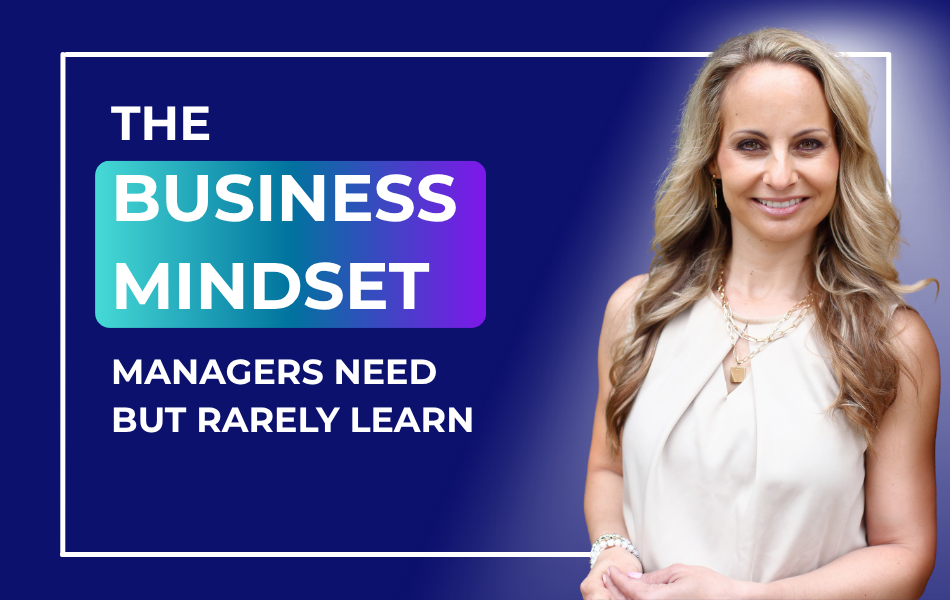
288. The Business Mindset Managers Need But Rarely Learn
The Business Mindset Managers Need But Rarely Learn
About this Episode
Ep. 288 – This week on The Manager Track podcast, we’re talking about one of the biggest role misunderstandings in management. Most managers think their job is to organize, divide, and execute the work. It feels productive and responsible, but it also keeps them stuck operating way below the level where real leadership value is created.
Because the true job of a manager is not just delivering output. It is deciding which work is worth doing, why it matters, and when to change direction entirely based on evolving context and capability.
This is the shift that separates managers who stay busy from managers who become strategic value creators.
In this episode, you’ll learn how to:
- See your team as a portfolio of bets instead of a backlog of tasks
- Think in time horizons, value multipliers, and capability creation
- Avoid defaulting back to IC execution mode when pressure shows up
Listen now on our Spotify, Apple Podcasts, and YouTube.
Listen on



share this story
This is episode 288, and we’re going to talk about some common misunderstandings of what it means to be a manager.
Here are the two questions. This podcast answers. One, how do you successfully transition into your first official leadership role? And two, how do you keep climbing that leadership ladder and continuously get promoted,
although the competition and the expectations get bigger. This show with The Manager Track podcast will provide the answers. I’m your host, Ramona Shaw.
I’m on a mission to create workplaces where work is seen as a source of contribution, connection and personal fulfillment. And this transition starts with developing a new generation of leaders who know how to lead. So everyone wins and gross. In the show, you’ll learn how to think, communicate and act as a confident and competent leader.
You know, you can be.
Welcome to this week’s episode of The Manager Track podcast.
Today we’re gonna talk about something that I’ve seen so many times in leaders who are trying to climb the ranks and get promoted, but somehow seem a bit stuck in their current position.
Or managers who are new in their leadership role and are trying to figure out what it really means to lead and how is this different from what my job was when I was an individual contributor. And there are a lot of different ideas that we make up of what it means to be a leader.
And this one here, sadly, often gets missed. So most managers think that their job is to organize the work, to coordinate tasks, and to deliver on what someone else has scoped out. And of course, on top of that, they need to get feedback to employees. They need to have one-on-one with employees. But all that is just gonna a means to the end and that end being to deliver on what someone else scoped at. Now this is a very common assumption and the problem is that this can lead to a lot of frustration and what I mentioned earlier, the stalled careers or in fact underperforming teams.
And so what I wanna do in today’s episode is to challenge that assumption and show you that that is actually often. Not at all what your job is supposed to be. Now there are a few exceptions, so I don’t know your job, your profession.
If you are in a role and it’s very clear that you as a manager are exactly supposed to do, what I just said is wrong, then hey, please do listen to your job description and listen to what your job tells you. But if you get a sense like, huh, when someone says, yeah, think more strategically or increase your contributions, or add more value add or think more about the business.
This type of feedback is a hint that what I’m going to tell you is exactly what applies to you. And the other thing I say here, I’m not calling this out to shame anyone.
I’m here to clarify what the real job of a manager actually is. Because once you see this more clearly, everything about how you lead changes. And the managers who don’t make this shift, who don’t realize that this is what’s happening and what’s at the core of the problem.
They’re often the ones who stay stuck in their current position or at that level. And companies might actually look at them and generally not quite understand what the unique value is that they add. And so. As you can see, when a company doesn’t know what the value is that you add, we’re gonna have a problem.
I hope this, this was compelling enough that you’re now interested in figuring out what exactly I’m talking about and how that applies to you. So I’m gonna get all of that in this episode.
So managing the work is not the same as managing the business value of the work. The real job of a manager is to actually make better decisions about what work should exist, why it matters,
how long it should live, this, whatever you deliver and what future optionality it creates, and we can go on what capability development is required to do this well and when is it time to kill or redirect a path that is no longer the most valuable use of time.
these were a lot of prompts on how you should be thinking about your job. But in essence, it’s about starting to see your team, like a portfolio of bets instead of a backlog of tasks. And it changes the altitude that you operate at.
Being in on the task level, being very operative versus being at a higher level and now actually thinking more strategically. It’s not that you don’t actually get involved in the day to day in the nitty gritty and into the details, but it is about how you think about the work and then how you present all that upwards and somewhat of a provocative truth here.
If a manager doesn’t learn this type of thinking, then eventually the work execution part will be automated, optimized,
or fully owned by processes and tooling and ai. All this delegating work, all this assigning tasks. And making sure that the work is done, that is the first thing that you could remove from a manager. The first thing that can get automated, the human role, is not to organize output. The leverage that you have as a manager
it’s in deciding which output is even worth doing. And that is key. So let me walk you through a few wrong role assumptions to really bring this to the point.
The first assumption is that my job is to organize and deliver the work that was assigned. No. Your job is to think like a business owner, not like a project scheduler. You are consistently supposed to evaluate whether the work that your team is doing makes sense, what future value it creates, what trade-offs it requires, and whether it is better to pivot or reinvest somewhere else.
Everything that your team does now comes at an opportunity cost. Because you can’t do all the things that are possible for you and your team to do. You have to make those choices. And so you are the one who’s making those judgment calls and what is the work that you’re supposed to be doing?
And if you have a manager who’s currently telling you or making those judgment calls, then you need to be the one. Who understands the judgment calls, who challenges them when necessary, who prepares arguments if you feel strongly that this judgment call is wrong in order to manage upward and influence.
Wrong assumption. Number two is that becoming a manager is kind of just being a little bit more than a great ic. No. Becoming a manager is a career identity switch.
It is a different job and entirely, and if you keep doing your version of a high performing IC and you work like that, but you’re now in the manager seat, you will stall and not be effective. And maybe your team is gonna have a hard time with you too. ’cause they’re the ones who were supposed to be doing the work.
You are supposed to be the one who’s taking on the manager role, not the to somewhat elevated ic. So you are really no longer measured by how much you can individually produce. You are measured by the value, not the number of hours, but the value the team is able to produce.
Because of how you think and the decisions that you make. If that all sounds like, oh my gosh, I get it now. Read my book, the Competent and Confident New Manager, we’re gonna talk about four specific shifts that you need to go through in order to move from a high performing IC into an effective leader.
Those shifts, for most of us, don’t come natural. We have to be aware of them and we have to do them intentionally. That is what helps you be set up for success as a confident and competent manager. This is not rocket science.
The biggest problem that managers have why almost 60% of new managers fail or underperforming their first two years is because they’re missing this information. They weren’t taught this, they didn’t have access to that knowledge. So if that is you, or if you are supporting someone who’s currently moving into a leadership role, then get a copy of that book. We’ll include a link in the show notes. Okay. On two wrong assumption number three. The assumption that value is created through short term outputs, like the things that you, the value that you add right now, while there is value in short term output, this is not where you should be focusing on the value that you wanna pay attention to is the one that’s created over time. Through capability building, through effective prioritization, smart sequencing, and knowing which bets are worth placing and which ones you should end. What is work that you should no longer be doing? What is work that you should be doing differently?
What is work that you need to start doing in order to be ready to contribute this value in 6 to 12 months? Because you see how the market is changing or how the business is shifting. And this is what separates managers who build careers with leverage and upward mobility
versus the ones who constantly have to prove themselves through the output and the activity that they’re completing. So if you feel like, Hey, I’ve been trying to do more in order to prove my worth as a leader, let me just do one more project. Let me just get this additional win. I am here to challenge that, and I am suggesting that you ask yourself.
What are the highest value bets this team could be solving right now? What are future capabilities that I’m intentionally growing through this work? Or that we as a team should be growing? And where am I stuck solving legacy problems simply because they’re familiar, but they’re not gonna be value adding in the future?
And so this mindset shift is one of the most important to unlock in leadership development. And most companies don’t call that out. And if they do give feedback, they give feedback in a very vague way. Like consider the business more, think outside of your team, become more strategic.
But all that is like. I don’t even know what that means ’cause I’m busy executing my day to day and I don’t know where in this process I should be thinking more strategically. It can be hard to connect even if you intellectually totally understand what someone means, it can be hard to actually apply this in our day to day.
And the reason for this is that. The mindset shift, the way that we’re thinking about our role as a manager is off. And so I hope that calling out those three different sort of false assumptions really highlighted this mismatch in mindset. by the way, this false idea of what a manager should be doing is also why many executives believe that they have more managers than they need because they are looking at managers only creating operational throughput instead of strategic value. So if you are in a company or in an industry where you realize like, Hey, management layers are getting thinner and thinner, they’re cutting more middle managers because they believe the ratio between employer IC and manager is off.
And so they’re reducing the number of managers in the org. If you are a manager who’s focused on the output and organizing that output you might be one that they’re gonna have a hard time just justify keeping.
But if you are someone who thinks and operates differently in your manager role, and you’re asking yourself the questions I listed a few minutes ago, that really help you think about your role. And the value that you create with your team differently,
this is how you’re gonna show up as more strategic, as more value driven.
So the question to close this out today. Is if the real role of a manager is actually this more strategic, value driven identity, what is one small shift that you can make this week that moves you away from being a task administrator toward a more strategic owner?
Maybe that means you finally kill a project that has been dragging forward out of inertia instead of value. Maybe it means to re-scope where your team’s energy goes this month. Maybe that means you start explicitly naming the bets you are making and why, especially now at the time of this release of this episode, many leaders including possibly you are thinking about the 2026 strategic plans, and so.
Think about the bets that are on the table. Think about which bets you want to make and why. And if you manage other managers, then this is the exact shift you need to coach them towards so that they understand that the value of a manager is not in running meetings, having one-on-ones giving feedback, updating timelines or moving tasks across ban boards.
That’s all great and needed, right? But the value of a manager is in choosing what is actually worth working on and helping a team continuously build capability to solve higher value problems over time. And ultimately this is how you future prove your leadership career.
It is how you get promoted more consistently and it is how you become a leader. People trust with bigger and more ambiguous opportunities. So if you found this helpful and you know, a new manager or a mid-career manager who is stuck doing exactly this, or you realize like, this is something I’m trying to share with my managers and the team, share this episode with them.
And as I said, if you wanna go deeper into the mindset shifts needed in order to succeed as a leader, then check out my book, the confident and competent new manager on Amazon.
That is it for today. Thanks so much for tuning in. I hope this was thought provoking and planted some seeds so that you are reflecting on
what is actually your role as a manager and what is the value that you are uniquely positioned to deliver for the company? We’ll be back next week with another Episode in The Manager Track podcast. Bye for now.
If you enjoy this episode, then check out two other awesome resources to help you become a leader. People love to work with. This includes a free master class on how to successfully lead as a new manager. Check it archova.org/masterclass.
The second resource is my best-selling book, the confident and competent new manager, how to quickly rise to success in your first leadership role. Check it out at archova.org/books or head on over to Amazon and grab your copy there.
You can find all those links. In the show notes down below.
REFLECTION & DISCUSSION QUESTIONS
- Am I leading my team or just managing tasks?
- What’s one thing we’re doing that no longer adds real value?
- How can I start thinking more like an owner, not just a doer?
RESOURCES MENTIONED
- Grab the free New Manager Toolkit mentioned in the episode: archova.org/freetoolkits
- Learn how to turn your 1-on-1 meetings from time wasters, awkward moments, status updates, or non-existent into your most important and valuable meeting with your directs all week. Learn more at: https://archova.org/1on1-course
- Let us know what you think by sending an email to contact@archova.org
- Schedule a Leadership Strategy Call with Ramona HERE.
- Grab your copy of Ramona’s best-selling book ‘The Confident & Competent New Manager: How to Rapidly Rise to Success in Your First Leadership Role’: amzn.to/3TuOdcP
OTHER EPISODES YOU MIGHT LIKE
- Episode 185 – Ownership Mindset
- Episode 221 – How to Spot and Overcome a Victim Mindset
WHAT’S NEXT?
Learn more about our leadership development programs, coaching and workshops at https://www.archova.org/
Grab your copy of Ramona’s best-selling book ‘The Confident & Competent New Manager: How to Rapidly Rise to Success in Your First Leadership Role’: https://amzn.to/3TuOdcP
Want to better understand your leadership style and patterns? Take our free quiz to discover your Manager Archetype and learn how to play to your strengths and uncover your blind spots: https://archova.org/quiz
Are you in your first manager role and don’t want to mess it up? Watch our FREE Masterclass and discover the 4 shifts to become a leader people love to work for: https://www.archova.org/masterclass
Love the podcast and haven’t left a review yet? All you have to do is go to https://www.ramonashaw.com/itunes and to our Spotify Page, and give your honest review. Thanks for your support of this show!
If this episode inspired you in some way, take a screenshot of you listening on your device and post it to your Instagram Stories, and tag me https://www.instagram.com/ramona.shaw.leadership or DM me on LinkedIn at https://www.linkedin.com/in/ramona-shaw